

Sri Lanka Wildlife Guide 2026 | Every Animal You May See
Yala National Park Complete Wildlife Species Guide 2026: Every Animal You Might See (Identification & Probability)
Complete Yala wildlife species guide 2026 all 44 mammals, 215 birds, 46 reptiles. Identification tips, sighting probability, behavior, seasonal patterns. What animals will you actually see at Yala?
The Complete Animal Kingdom of Yala National Park
Yala National Park is home to 44 mammal species, 215 bird species, and 46 reptile species — more than 300 distinct animals across a single 979 square kilometre landscape. Yet most visitors can name only three: leopard, elephant, and crocodile.
This guide teaches you the complete animal kingdom of Yala — not as a checklist, but as an understanding of what you are actually likely to encounter, where you will find each species, how to identify them in the moment, and what their presence tells you about the ecosystem.
The visitor who can identify twenty species by sound, sight, and track is having a fundamentally different safari experience than the visitor scanning for leopards. Both are valid. This guide serves both.
Part 1: The Mammals The Animals Visitors Come For
The Big Cats
Sri Lankan Leopard (Panthera pardus kotiya) — The Icon
Sighting probability:
* Block 1: 60–90% per drive (dry season)
* Block 5: 60–75% per drive
* Off-season: 30–50% per drive
Identification:
* Golden-tawny coat with black rosette patterns (not solid black spots)
* Larger than you expect (60–80 kg males are genuinely substantial)
* Long tail used for balance on trees
* Head smaller and more delicate than other big cats
* Whiskers visible at 30+ metres with binoculars
Behavior:
* Solitary (you rarely see more than one)
* Most active dawn and dusk
* Apex predator with no natural enemies (explains daytime activity and lack of fear)
* Territorial (same individuals occupy same territories year to year)
* Tree climbers (often rest on branches or rock overhangs)
* Excellent hunters (successful kill rate 20–25% of attempts, highest of all big cats)
Where to find them:
* Granite inselbergs (thermoregulation sites in morning/evening)
* Dense scrub forest edges (hunting territory)
* Near waterholes (predator waiting ambush points)
* Tree branches above tracks (resting spots)
* Coastal dunes near Patanangala (part of their territory)
Signs you've missed one:
* Fresh pugmarks in red laterite (more common than actual sighting)
* Alarm calls from sambar deer (indicates predator presence)
* Prey remains in tree forks (leopard kill cache)
* Scat (droppings) on rocks at territory boundaries
Why Sri Lanka's leopards are different: The Sri Lankan subspecies is larger and bolder than African or Indian leopards due to million years of isolated island evolution. Without competition from lions or tigers, they occupy a unique ecological niche.
The Elephants — The Gentle Giants
Sri Lankan Elephant (Elephas maximus maximus) — The Largest Land Animal
Sighting probability:
* Block 1: 70–90% per drive (year-round)
* Block 5: 80–95% per drive (larger herds)
* Yala total population: 300–350 individuals
Identification:
* Largest land animal (up to 6 tonnes)
* Grey skin (not brown)
* Large ears (Asian elephants have smaller ears than African)
* Single dome on forehead (African elephants have twin domes)
* Trunk with finger-like tip (used for incredible dexterity)
* Tusks (about 8% of males have prominent tusks; females rarely have visible tusks)
Behavior:
* Highly social (live in family herds led by matriarch)
* Intelligent (problem-solving, emotional depth, memory)
* Communicate via infrasound (calls below human hearing range)
* Spend 16–18 hours per day feeding
* Need 150–200 litres of water daily
* Excellent swimmers and water lovers
Where to find them:
* Waterholes (guaranteed in dry season)
* Grassland edges (grazing habitat)
* Forest clearings (feeding areas)
* River crossings (water sources and movement corridors)
* Block 5's Weheragala Reservoir (largest single concentration in Yala)
Signs you've missed one:
* Elephant dung (large balls, 15 cm diameter, packed with fibrous material)
* Footprints (enormous circular depressions)
* Browsed trees (stripped bark, broken branches higher than human reach)
* Path damage (wide trails through vegetation from repeated use)
Why they matter: Elephants are megafauna that shape the ecosystem. Their feeding creates grasslands where leopards hunt. Their water access creates waterholes other animals depend on. Their presence indicates habitat health.
The Bears — The Rare Surprise
Sri Lankan Sloth Bear (Melursus ursinus inornatus) — The Elusive Bear
Sighting probability:
* May–July (Palu season): 60–75% per drive
* Other months: 15–25% per drive
* Year-round population: Estimated 50–100 individuals in Yala
Identification:
* Shaggy black fur (distinct from other bears)
* Curved claws (specialized for digging termites)
* V-shaped white or cream chest marking (distinctive)
* Long mobile upper lip (used for sucking insects)
* Medium size (100–140 kg, much smaller than leopards)
* Slow, deliberate movement (not quick like other animals)
Behavior:
* Primarily nocturnal (active at night)
* Solitary or mother-with-cubs
* Insectivorous (termites, ants, bees are primary food)
* Palu fruit specialist (specific fruiting season makes them visible)
* Generally shy and avoid humans
* Can be aggressive if surprised (standing on hind legs and hissing)
Where to find them:
* Palu trees (May–August, climbing trees to eat fruit)
* Termite mounds (year-round feeding)
* Forest floor (foraging at dawn/dusk)
* Dense scrub forest (shelter during day)
Signs you've missed one:
* Overturned soil at termite mounds (claw marks, excavation)
* Scat with insect remains (distinctive odor)
* Claw marks on tree bark (reaching for fruit or insects)
* Hair caught on branches
Why they're special: Sloth bears are the rarest of Yala's Big Three. A confirmed sighting is genuinely exciting. Their presence during Palu season transforms the safari into something unexpected.
The Ungulates — The Prey Animals
Spotted Deer/Axis Deer (Axis axis) — The Abundant
Sighting probability: 100% (virtually every drive)
Identification:
* Golden-tan coat with white spots (spots never disappear, unlike fawns that lose spots)
* Lyre-shaped antlers (distinctive curved shape)
* Males larger than females
* White tail with black stripe (raised when alarmed)
* Herd animals (often seen in groups of 5–20)
Behavior:
* Primary leopard prey (hunting success 20–30% of attempts on Spotted Deer)
* Alarm bark distinctive (single sharp repetitive bark)
* Graze at dawn/dusk, rest during heat
* Excellent hearing and smell (detect predators at distance)
* High reproduction rate (fawns born throughout year)
Where to find them:
* Grasslands (primary habitat)
* Forest edges (feeding transition zones)
* Waterholes (drinking times)
* Anywhere in Block 1 and Block 5
Wild Water Buffalo (Bubalus arnee) — The Robust Grazers
Sighting probability: 80–90% per drive
Identification:
* Massive body (up to 1,000 kg)
* Curved horns (distinctive lyre shape, much larger than cattle)
* Dark grey to black coat
* Stocky legs (built for swamp habitat)
* Often seen in small herds (3–8 individuals)
Behavior:
* Herd animals
* Prefer wetland habitat
* Can be aggressive if threatened (rarely approached by predators due to size and herd defense)
* Excellent swimmers
* Less commonly hunted by leopards (size makes them difficult prey)
Where to find them:
* Lagoons and wetland areas
* Grasslands bordering water
* Block 1's wetter zones
Sambar Deer (Rusa unicolor) — The Forest Dweller
Sighting probability: 50–70% per drive
Identification:
* Darker brown coat than Spotted Deer
* No spots (different from spotted deer despite both being deer)
* Sturdy build
* Single long track antlers (males only)
* Larger than Spotted Deer
* Often solitary or in small groups (2–3)
Behavior:
* Forest inhabitant (prefers scrub and dense vegetation)
* Excellent alarm barker (loud repetitive bark signals danger)
* This alarm call is often your first alert that a leopard is nearby
* Nocturnal and crepuscular (active at dawn/dusk, rest during day)
Where to find them:
* Dense forest edges
* Scrub vegetation
* Less visible than Spotted Deer due to forest preference
The Primates — The Vocal Animals
Gray Langur (Semnopithecus priam) — The Leaf-Eaters
Sighting probability: 70–80% per drive
Identification:
* Grey-brown coat
* Long tail (used for balance in trees)
* Large body (2–6 kg)
* Live in groups (10–30 individuals)
* Distinctive loud calls (cascading warning screams)
Behavior:
* Arboreal (tree-dwelling)
* Leaf specialist (digestive system adapted for leaves)
* Vigilant alarm system (calls warn of predators to entire group)
* Complex social hierarchy within groups
* Excellent jumpers (leap 15+ metres between trees)
Where to find them:
* Canopy trees
* Forest patches
* Areas with adequate vegetation
Why they matter for safari: Langur warning calls are one of your most important clues. A cascading call from the canopy usually means something is moving on the forest floor below — often a leopard or large predator.
Toque Macaque (Macaca sinica) — The Endemic Monkey
Sighting probability: 40–60% per drive
Identification:
* Smaller than langurs (2–3 kg)
* Grey-brown coat
* Distinctive crest on head (looks like a punk hairdo)
* Short tail (unlike langurs' long tails)
* Live in troops (10–30 individuals)
* More aggressive and mischievous than langurs
Behavior:
* Ground and tree foragers
* Opportunistic feeders (omnivorous)
* Loud vocalizations (chattering, screaming)
* Defined social hierarchy
* Often raid campsites for food
Where to find them:
* Mixed habitat (ground and trees)
* Areas near human activity (bolder than langurs)
The Carnivores — Beyond the Leopard
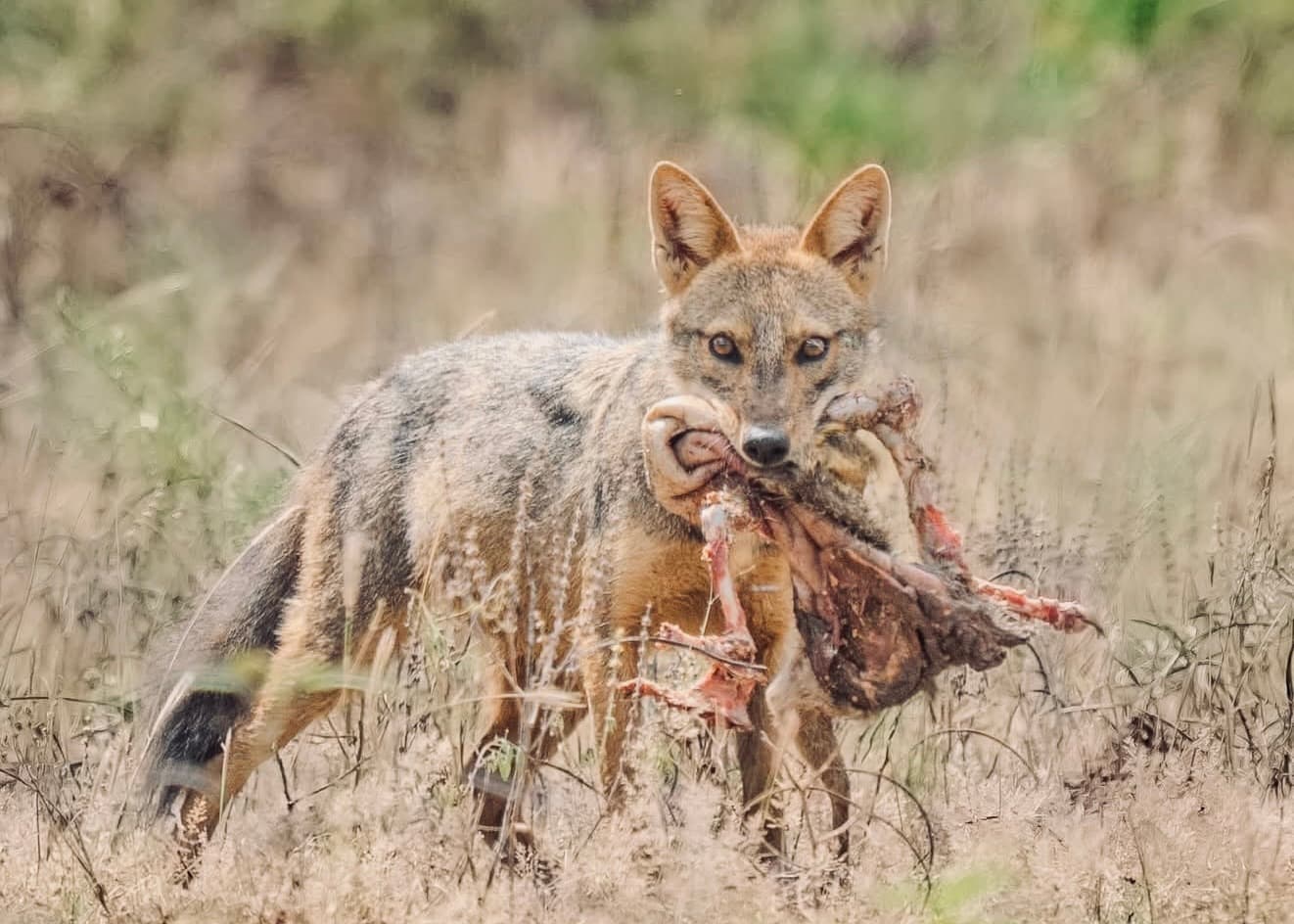
Golden Jackal (Canis aureus) — The Opportunist
Sighting probability: 40–60% per drive
Identification:
* Dog-like appearance (smaller than domestic dog)
* Tawny-gold coat
* Pointed ears
* Bushy tail
* Often seen alone or in pairs
* Active morning and evening
Behavior:
* Scavenger and hunter
* Opportunistic feeder (eat leftovers from leopard kills)
* Vocal (distinctive yipping calls at dawn/dusk)
* Territorial (maintain same territory year to year)
* Less feared than they appear (actually quite timid despite canine appearance)
Where to find them:
* Open grasslands
* Areas with visible sightlines
* Often near waterholes
Why they matter: Golden jackals are often the first animals to move in after a leopard kill. Their presence can indicate recent predation.
Mongoose Species (6 types) — The Tiny Carnivores
Sighting probability: 30–50% per drive
Common species:
* Common Grey Mongoose (largest, 20 cm body)
* Ruddy Mongoose (reddish coat)
* Spotted-necked Otter (semi-aquatic)
Behavior:
* Highly aggressive despite small size
* Fearless hunters
* Use rock crevices for shelter
* Diurnal (active during day)
* Often seen crossing tracks
Where to find them:
* Rock areas
* Grassland edges
* Near water (some species)
The Reptiles and Other Mammals
Mugger Crocodile (Crocodylus palustris) — The Waterholes' Owner
Sighting probability: 60–80% per drive
Identification:
* Prehistoric appearance (ancient-looking)
* Brownish-grey scaly hide
* Eyes and nostrils on top of head (allows breathing/seeing while submerged)
* 3–4 metre length (some larger)
* Often basking on banks
Behavior:
* Apex aquatic predator
* Ambush hunters (lie motionless in water)
* Territorial (defend waterholes)
* Surprisingly fast on land over short distances (not sustained pursuit)
* Vocal (bellowing and hissing)
Where to find them:
* Coastal lagoons
* Waterholes
* Rivers and water bodies
* Often fully submerged with only eyes visible
Why they matter: Crocodiles indicate healthy water ecosystems and add drama to waterhole scenes. Their presence is generally harmless to safari-goers (they avoid humans).
Monitor Lizards (Varanus bengalensis) — The Ground Reptiles
Sighting probability: 50–70% per drive
Identification:
* Large lizards (body length 1–1.5 metres)
* Mottled grey-brown coat
* Powerful tail
* Alert and aware behavior
* Often crossing tracks
Behavior:
* Excellent runners (can move quickly on land)
* Hunt smaller animals
* Keen sense of smell
* Solitary
* More common than dangerous (genuinely shy)
Where to find them:
* Open grassland
* Track crossings
* Forest edges
Part 2: The Birds — 215 Species
The complete bird list at Yala is extraordinary. Rather than listing all 215, here are the ones most visitors identify:
The Iconic Birds
Peacock (Pavo cristatus) — The Display Artist
Sighting probability: 90%+ per drive
Identification:
* Impossibly beautiful iridescent blue head and neck
* Emerald-green body
* 1-metre-long tail feathers
* Unmistakable silhouette
Behavior:
* Males display courtship tail (fanning all 200+ feathers)
* Loud call (distinctive "meow" sound despite being a bird)
* Territorial and loud
* Often in pairs or small groups
* Display most common at dawn
Where to find them:
* Everywhere in Yala (grasslands, forest edges, open areas)
* First animals you see most mornings
Painted Stork (Mycteria leucocephala) — The Wetland Specialist
Sighting probability: 70–80% per drive (especially at lagoons)
Identification:
* Large wading bird (90 cm tall)
* White and black plumage (distinctive pattern)
* Red and yellow head (unfeathered)
* Long legs
* Often seen in groups
Behavior:
* Wades in shallow water
* Feeds on fish and aquatic creatures
* Migratory (northern winter residents)
* Colonial (nest in groups)
Where to find them:
* Coastal lagoons
* Shallow water areas
* Wetland edges
Purple Heron (Ardea purpurea) — The Shy Wader
Sighting probability: 40–60% per drive
Identification:
* Smaller than Grey Heron
* Mottled brown-purple plumage (camouflaged)
* Yellow eyes
* Long thin neck (hunched posture)
* Often solitary
Behavior:
* Excellent camouflage
* Stalking hunter (stands motionless waiting for prey)
* Solitary
* More commonly heard than seen (distinctive croaking call)
Where to find them:
* Dense aquatic vegetation
* Lagoon margins
* River edges
Grey Hornbill (Ocyceros birostris) — The Canopy Call
Sighting probability: 60–70% per drive
Identification:
* Large bird (30 cm)
* Black and white plumage
* Long curved bill
* Distinctive call (loud, mournful sound)
Behavior:
* Arboreal (tree-dwelling)
* Frugivorous (fruit-eaters)
* Loud vocalizations (calls across the forest)
* Often seen in small groups
Where to find them:
* Canopy trees
* Forest patches
* Areas with fruit-bearing trees
The Birds Guides Always Point Out
Black Eagle — Large raptor, soaring overhead Crested Serpent Eagle — Hunting snakes in trees Jungle Fowl (endemic) — Ground-dwelling, pheasant-like Kingfishers (3+ species) — Brilliant colors at water's edge Bee-eaters — Aerial hunters Hoopoe — Distinctive crest, striking patterns Woodpeckers (several species) — Tree excavators Pigeons (multiple species) — Ground and tree feeders Parrots (2–3 species) — Loud calls in canopy
The Migrant Birds (November–March)
During winter in Europe and Asia, thousands of migratory birds descend on Sri Lanka:
Winter warblers — Dozens of species from Siberia Raptors — Steppe Eagles, Pallid Harriers from Central Asia Waders — Plovers, sandpipers, curlews from Arctic breeding grounds Herons and egrets — Migratory populations expand resident populations
This influx of migrants in dry season makes November–March a birder's paradise.
Part 3: Seasonal Variations — Which Animals When
Dry Season (February–June)
Advantages for wildlife:
* Water concentrated in fewer locations → animals predictable
* Reduced vegetation → easier visibility
* Palu fruit season (May–August) → sloth bears visible
* Migratory birds still present (early months)
Best animals dry season: All residents visible + sloth bears appearing (May onward)
Green Season (November–January)
Advantages:
* Lush vegetation
* Migratory birds arriving
* Water abundant everywhere
* Fewer tourists
Disadvantages:
* Thick vegetation reduces visibility
* Animals dispersed across larger territory
* Leopard sightings less probable (30–50% vs 60–90%)
Part 4: Reading Animal Signs — Tracking Without the Animal
Pugmarks (Paw Prints)
Leopard tracks:
* Four-toed prints
* Claw marks absent (retractable claws)
* Circular pad
* Size roughly 3–4 cm
Fresh vs old:
* Wet from overnight dew = very recent (last 30 min)
* Drying = 1–2 hours old
* Dried and hard = several hours old
Scat (Droppings)
Leopard scat:
* Cylindrical
* Often contains hair
* Typically deposited on rocks at territory boundaries
* Distinctive smell
Ungulate scat:
* Spotted Deer: small pellets in clusters
* Buffalo: large flattened piles
* Sambar: elongated pellets
Alarm Calls
The alarm call system:
* Sambar bark = predator nearby, alert system activates
* Peacock scream = distinct from territorial call, indicates danger
* Langur cascade = warning to others, prey animal fleeing
Understanding these calls allows you to track predators you never see.
Part 5: The Real Wildlife Experience
The wildlife at Yala is not a collection of species to check off a list. It is an ecosystem where every animal has a role:
* Peacocks display and call, territorial and beautiful
* Spotted Deer graze and alarm, food for leopards
* Elephants reshape the landscape, create waterholes others depend on
* Langurs feed in canopy, their calls alert others to danger
* Crocodiles control aquatic ecosystems, apex predators in water
* Leopards hunt at the top of the food chain, shaping prey behavior
* Jackals scavenge, occupy the margins of the ecosystem
* Monitor lizards hunt smaller creatures, visible hunters on ground
A visit where you see 20 species and understand each one's role is more complete than a visit where you see 50 species without context.
The Complete Species Checklist
Mammals you're virtually certain to see (90%+ probability):
* Spotted Deer
* Wild Water Buffalo
* Elephant (dry season)
* Peacock (bird, 90%+)
* Crocodile
* Langur or Macaque
Mammals you're likely to see (60–80%):
* Sambar Deer
* Golden Jackal
* Monitor Lizard
* Mongoose species
Mammals you might see (30–60%):
* Leopard (60–90% in Block 1 with proper planning)
* Sloth Bear (60–75% in Palu season May–August, 15–25% other months)
* Fishing Cat (10–15%, nocturnal and shy)
* Porcupine (10–15%, nocturnal)
Birds you're certain to see:
* Peacock
* Various raptors
* Herons and egrets
* Kingfishers
The Final Word: Yala's Complete Animal Kingdom
Yala is not just the leopard. It is 44 mammals, 215 birds, and 46 reptiles living in a 979 square kilometre space where every species has evolved to occupy a specific niche.
The visitor who sees the leopard and misses the ecosystem is seeing a fraction of what Yala offers. The visitor who understands that the sambar's alarm bark indicates the leopard is nearby, that the peacock's call marks territorial boundaries, that the crocodile is the waterholes' true owner — this visitor is having the complete Yala experience.
Know the animals before you arrive. Listen for the calls. Read the tracks. Understand each species' role.
The animal kingdom of Yala is waiting.
Last updated: May 2026 | Wildlife information verified against current 2026 field observations, Department of Wildlife Conservation data, and verified naturalist knowledge from guides with 10+ years Yala experience
Ready to see this in real life?
Book your Yala safari today and experience the magic firsthand.
Explore Packages